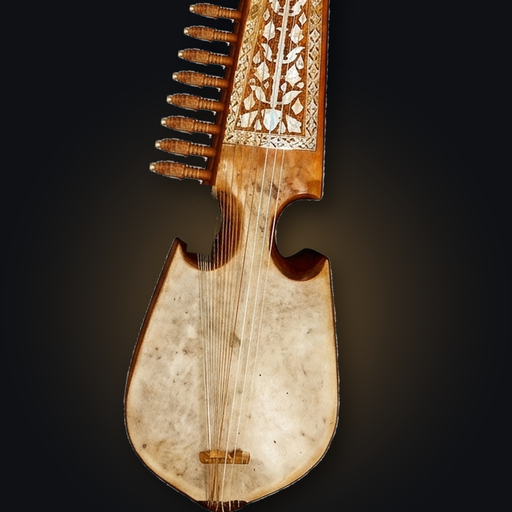
How to tune an Afghan rubab
The string names, the notes and frequencies, why there is no single correct pitch, and a sensible order to work through — from the three melody strings down to the sympathetics that most tuners ignore.
Written for the Afghan rubab — also spelled rabab and robab · Last updated 1 August 2026
The short answer
The three melody strings of the Afghan rubab are tuned in perfect fourths. The most widely used starting point, and the one this app ships with, is E3 – A3 – D4. The steel drones sit an octave below, and the sympathetics are tuned to the scale of whatever you are about to play.
At A=440, the standard eighteen-string setup looks like this:
| String | Role | Note | Frequency |
|---|---|---|---|
| Katay | Melody · nylon or gut | E3 | 164.81 Hz |
| Bam | Melody · nylon or gut | A3 | 220.00 Hz |
| Zer | Melody · nylon or gut | D4 | 293.66 Hz |
| Shahtar 1 | Drone · steel | A2 | 110.00 Hz |
| Shahtar 2 | Drone · steel | D3 | 146.83 Hz |
| Bachi 1–13 | Sympathetic · steel | D4 → B5 | 293.66 – 987.77 Hz |
Rabab, rubab or robab?
They are the same instrument. The name comes into English from Dari and Pashto, and there is no single agreed transliteration, so you will see rubab, rabab, robab and Kabuli rebab used for the short-necked plucked lute of Afghanistan — the one with the waisted body carved from a single block of mulberry, a skin soundboard, gut or nylon melody strings and a bank of sympathetics running down the side.
One word is worth reading carefully. The rebab, spelled that way, is normally a different and much older instrument: a bowed spike fiddle found across North Africa, the Middle East and Southeast Asia. Search results mix the two constantly. If a page is describing a bow, it is not talking about the Afghan rubab.
This site uses rabab and rubab interchangeably, because that is how players actually write it.
What the strings are called
A rubab has far more strings than it has things you play. A standard instrument carries eighteen, in three groups:
The three melody strings
These are the strings you actually fret and pluck, on the fingerboard, running over the frets. From low to high they are Katay, Bam and Zer. They are gut or nylon, and they behave like it — soft attack, a pitch that settles rather than arrives, and a noticeable sag as the note decays.
The Shahtar drones
Two or three steel strings — the count varies by instrument and by maker — tuned an octave below the melody strings. They are not fretted. They are struck open, as a drone under the melody, and they are what gives the rubab its low ringing floor. In an E–A–D setup they are normally A2 and D3, doubling Bam and Zer an octave down.
The Bachi sympathetics
Eleven to fifteen thin steel strings running down the side of the neck, each on its own small peg. You never pluck these. They vibrate on their own when a melody note matches one of their pitches, which is where the instrument's halo of resonance comes from. Because they respond to the notes you play, they have to be tuned to the scale you are playing — which is why the Bachi are retuned far more often than anything else on the instrument.
Not every rubab is built to the standard. Two Shahtar or three; eleven Bachi or fifteen; four frets or eight; pegs arranged three-and-two or two-and-three. None of that is wrong — it is a hand-built instrument. It does mean a generic string chart will often not match what is in your hands.
Why the tuning is relative, not absolute
This is the part most tuning charts get wrong by omission.
The rubab is not a piano and is not usually played against fixed-pitch instruments in the Western sense. What the tradition fixes is the relationship between the three melody strings: two stacked perfect fourths. Where that stack sits in absolute pitch is a decision, and the decision belongs to the player, the teacher, the region, the singer you are accompanying, and quite often the instrument itself.
So E3–A3–D4 and C#–F#–B are not rival "correct answers". They are the same shape at different heights. A player who tunes to C# is not playing a mistuned E instrument; they have set the tonic lower, usually because it suits a voice, a teaching lineage, or an instrument that does not enjoy carrying more tension than it has to.
Your instrument has an opinion too
Beyond taste and tradition, the physical instrument sets real limits on where it wants to sit. Three things decide that:
- Size and scale length. Rubabs are hand-built and they are not all the same length. The distance from nut to bridge is what turns tension into pitch — a longer string at the same tension sounds lower. A large, long-scale rubab will therefore reach a comfortable working tension at a lower tonic, while a smaller or student-size instrument with a shorter scale naturally sits higher. Forcing a long-scale instrument up to a pitch meant for a short one means more tension than the body and the skin soundboard were built to carry.
- String gauge and material. Thicker strings reach the same pitch at lower tension; gut, nylon and modern synthetic all behave slightly differently. Changing brand or gauge can shift where the instrument feels right by a semitone or more.
- Age and condition. An older instrument, or one with a thin or well-worn skin, is often happier a step or two lower than the number on a chart.
The honest test is not a frequency — it is the instrument. If the melody strings feel tight and thin, the skin looks stressed, or the bridge is leaning, you are too high. If they are floppy, buzz on the frets and will not speak cleanly, you are too low. The correct tonic for your rubab is the one where it sounds full and the strings respond, and that pitch is a property of your instrument, not something a chart can tell you in advance.
A step-by-step order
Tuning a rubab in the wrong order means tuning it twice. Eighteen strings on one wooden body is a lot of tension, and moving any of it moves everything else slightly.
- Decide your tonic first. E–A–D, C#–F#–B, or whatever your teacher uses. Write it down if you are new to the instrument — it is the reference for everything below.
- Tune the three melody strings. Katay, then Bam, then Zer. Check the fourths by ear afterwards, not just against the meter: two strings can each read "in tune" and still sound sour together if you were sloppy at the edges of the tolerance.
- Come back to the melody strings a second time. They will have moved. Gut and nylon stretch, and the neck flexes very slightly as tension changes.
- Tune the Shahtar drones. An octave below their melody counterparts. These are steel and they hold well, but they are also thick and low, which makes them the hardest strings on the instrument for a phone tuner to read cleanly.
- Tune the Bachi last, to the scale of the raga. See below. They are thin, they go fast, and they are the reason the instrument sounds like a rubab rather than a fretted box.
- Play something and check again. A freshly tuned rubab is not a settled rubab. Five minutes of playing tells you more than another pass with the meter.
A note on the pegs
Rubab pegs are friction pegs — tapered wood in a tapered hole, held by nothing but friction. Push gently inward along the axis of the peg while you turn, and make the last movement of any adjustment a tightening one, coming up to the note from below. A peg that is set while loosening will keep drifting flat for the next ten minutes. If a peg slips constantly or squeaks and jumps, that is a fitting problem, not a tuning problem, and it wants peg compound or a luthier rather than more force.
Other common tunings
Anything in this table is a legitimate starting point. The interval structure is identical in every row; only the pitch centre moves.
| Tuning | Katay | Bam | Zer | Relative to E–A–D |
|---|---|---|---|---|
| E – A – D | E3 · 164.81 Hz | A3 · 220.00 Hz | D4 · 293.66 Hz | reference |
| D – G – C | D3 · 146.83 Hz | G3 · 196.00 Hz | C4 · 261.63 Hz | a tone lower |
| C# – F# – B | C#3 · 138.59 Hz | F#3 · 185.00 Hz | B3 · 246.94 Hz | a minor third lower |
C#–F#–B in particular is what a number of teaching traditions use, so if you are learning from a teacher or a school and their numbers do not match a chart you found online, that is very likely the reason — not an error on either side.
Tuning the Bachi to a raga
The sympathetics are the part no generic tuner helps with, because there is no single right answer to give. The Bachi should be tuned to the notes of the scale you are about to play, so that the ones you use ring and the ones you do not stay quiet.
A reasonable default — and a good place to start if you are not yet working within a specific raga — is a straight ladder up a major scale from the tonic. On a thirteen-Bachi instrument in D that runs D4 up to B5, roughly 293.66 Hz to 987.77 Hz: D, E, F#, G, A, B, C#, D, E, F#, G, A, B.
When you move to a raga or mode that uses flattened degrees, the corresponding Bachi move with it. This is normal and it is not a lot of work once you have done it a few times — the strings are short and thin and they respond quickly. It is, however, the single biggest reason a rubab player needs something better than a chromatic clip-on tuner.
When the tuning will not hold
- New strings. Gut and nylon stretch for days. Expect to retune several times a session at first — this is not a fault.
- Weather. A skin soundboard and a solid mulberry body react to humidity and temperature far more than a laminated instrument does. A cold room, a hot car or a wet week will all move the whole instrument.
- Slipping pegs. Friction pegs need the right fit. Squeaking, jumping or sudden release means the peg or the hole needs attention.
- One string pulling the others. Normal on a heavily strung instrument. It is why the order above says to make a second pass over the melody strings.
- A tuner that will not settle. Often the tuner, not the instrument. A plucked gut string falls in pitch as it decays, and a meter designed for steel guitar strings will follow that fall and never show a stable reading.
Doing this with the app
Rabab Tuner was built specifically because the steps above are awkward with general-purpose tuning apps. It draws your instrument — the number of Shahtar and Bachi you actually have, the fret count, the peg layout — and names the peg to turn rather than showing a needle and leaving you to work out which of eighteen strings it means.
- Set your own tonic, or use E–A–D, D–G–C or C#–F#–B as supplied.
- Per-string tolerance that accounts for a plucked nylon string sagging as it decays.
- The Bachi ladder retunes as a group when you change scale.
- Everything runs on the device, offline, with no account.
The app is not released yet. Leave your email on the home page and you will hear once it is on the App Store and Google Play — and see the full feature list in the meantime.
Questions
What notes is an Afghan rubab tuned to?
The three melody strings are tuned in perfect fourths. A common set is E3, A3 and D4 — 164.81 Hz, 220.00 Hz and 293.66 Hz at A=440. Many players and teachers use C#, F# and B instead. The interval between the strings is what matters; the absolute pitch varies.
Does the size of the rabab change its tuning frequency?
Yes. Scale length — nut to bridge — decides how much tension a given pitch needs, so a large, long-scale rubab reaches a comfortable tension at a lower tonic and a smaller instrument naturally sits higher. String gauge and material, and the age and condition of the skin, move it further. Tune to where your instrument sounds full and the strings respond, not to a number someone else published.
How many strings does a rabab have?
A standard instrument has eighteen: three melody strings, two or three Shahtar drones, and eleven to fifteen Bachi sympathetics. Hand-built instruments vary, and none of the common variations are wrong.
Can I tune a rubab with a normal guitar tuner?
Partly. A chromatic tuner will read the pitch of one string, which covers the three melody strings if you already know the note you want. It will not know your string names, will not know how many Bachi you have or what scale they belong on, and will not tell you which peg to turn. It will also tend to chase the pitch of a plucked nylon string as it sags.
Is the rabab the same as the rubab?
Yes — different transliterations of the same word. The rebab, spelled that way, is usually a different, bowed instrument.
Do I have to retune the Bachi for every piece?
Only when the scale changes. Within one raga or mode they stay put. Moving to a mode with different flattened degrees means moving the corresponding sympathetics.
Why does my rubab go out of tune so quickly?
New gut or nylon strings stretch for the first few days, friction pegs can slip if they are not well fitted, and a skin-topped wooden instrument reacts strongly to humidity and temperature. All three are ordinary and all three are fixable.