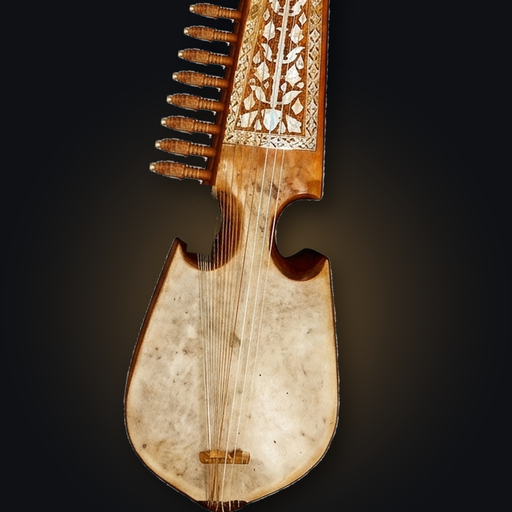
Everything Rabab Tuner does.
Eleven parts of one app, all of it running on your phone. Everything below is what the app actually does, described the way a player would describe it — and all of it is included in the one subscription, with a free trial to start.
Built for the Afghan rubab — also written rabab or robab, and called the Kabuli rubab — not for guitars, and not for the bowed rebab.
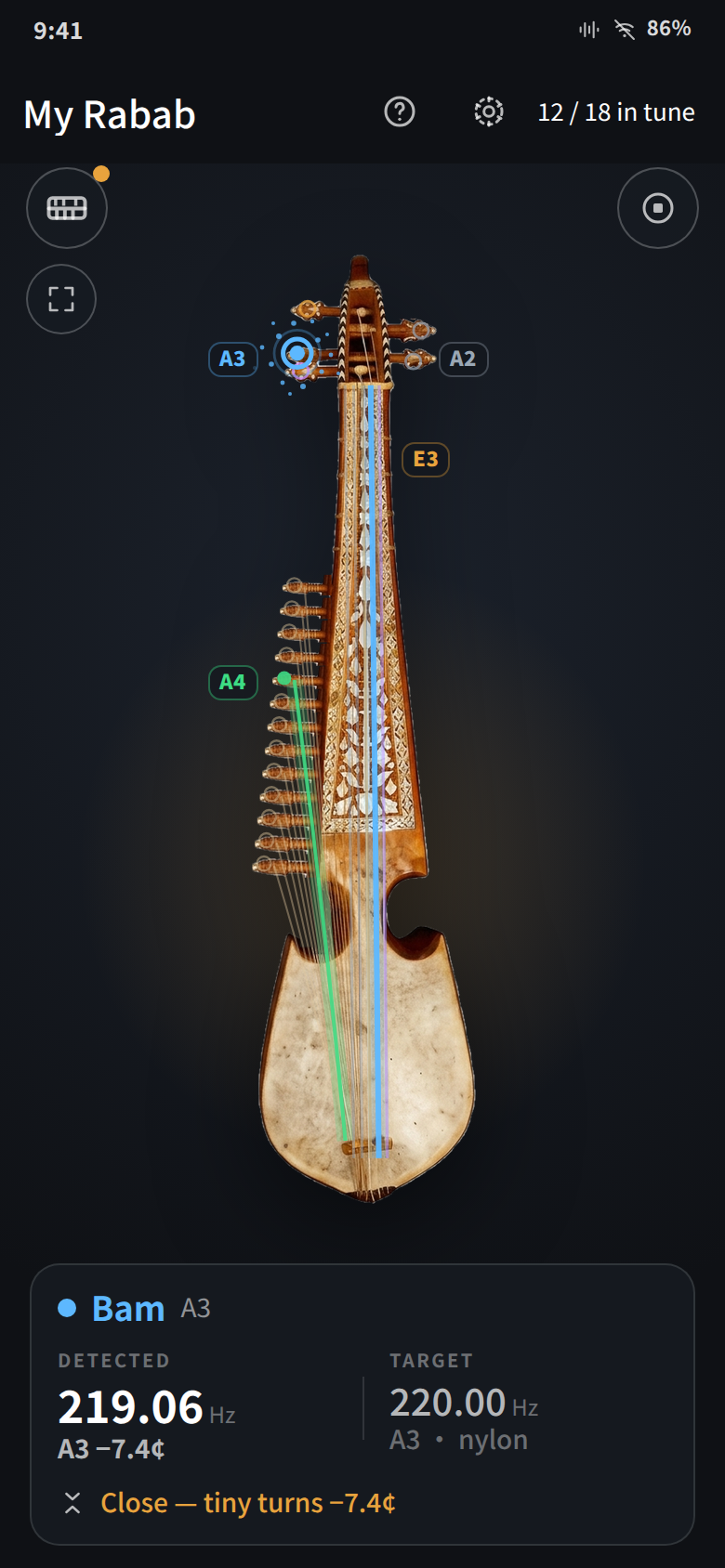

Live preview — this is the app running, not a video
Made for a string that won't sit still.
A plucked string is a moving target. It sags a little as it rings, and the thick low Shahtar are the hardest of all to read — their sound is full of higher notes that fool ordinary tuners. Rabab Tuner was built around exactly this instrument, so it follows the pitch as it settles instead of jumping about.
- In tune means in tune — the string has to hold steady, not just pass through the right spot for a moment.
- It uses words — "Loosen peg · sharp", "Close — tiny turns", "Hold steady…", then a green "In tune".
- It knows what you played — pluck any string and the right one lights up, even without choosing it first.
- Fretted notes too — play up the neck and it reads "Katay · fret 3", not just open strings.
- It never tunes to itself — while it is playing you a reference note, it stops listening.
- The screen stays awake while you tune, and comes back on its own if something interrupts the microphone.
In short
- What it can hearevery string on the Rabab
- How often it answersabout 50 times a second
- Close enoughwithin 5 cents
- When it locksonce it holds there
- The diala quarter tone either side
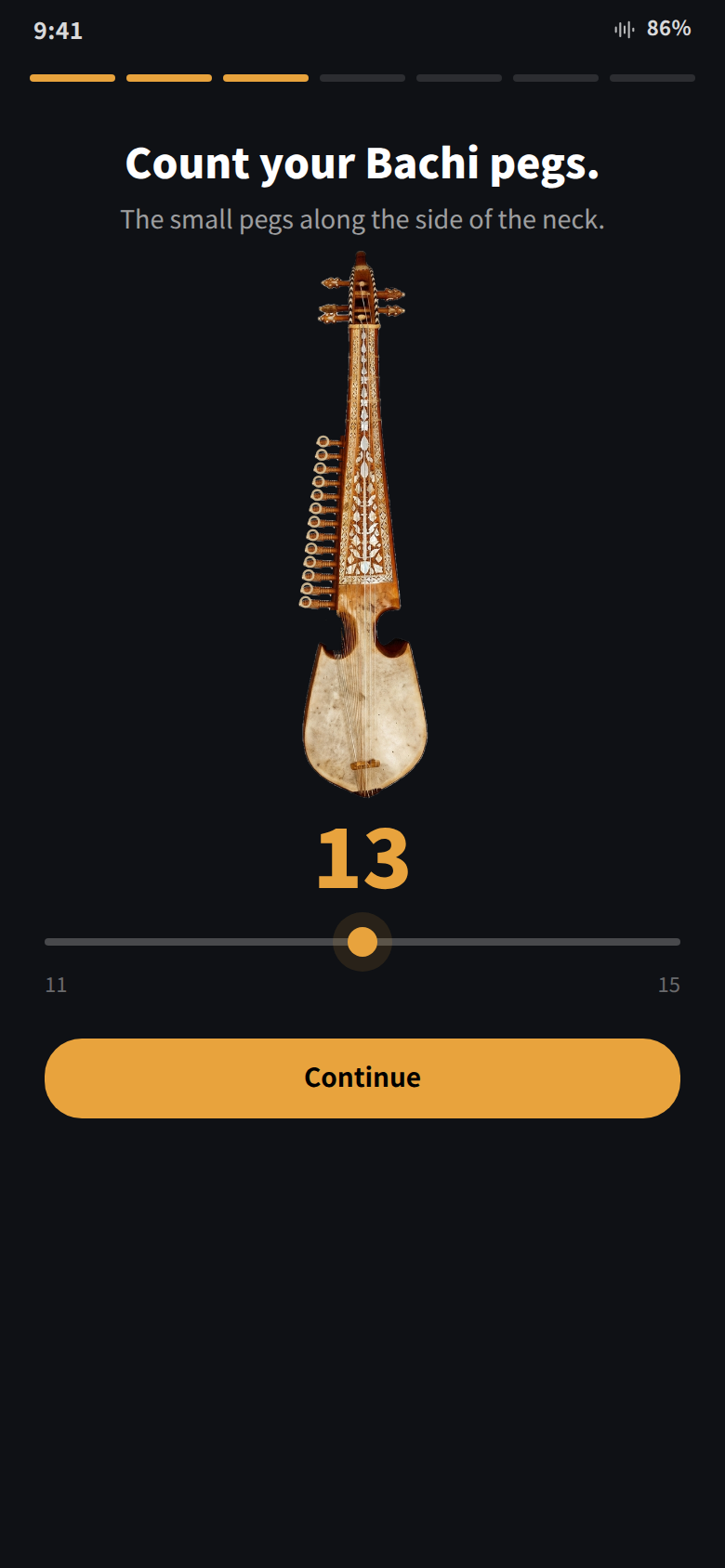
The picture is redrawn for your Rabab.
No two Rababs are the same, so the app asks. Five questions later the instrument on screen is yours: the right pegs on the headstock, the right number down the Bachi rail, frets in the right places, and every string tied to the peg that actually tunes it.
- 2 or 3 Shahtar · 11 to 15 Bachi · 4 to 8 frets · pegs 3+2 or 2+3
- Any concert pitch — 440, 444 with a tabla, or wherever your group plays.
- Swap the pegs around — choose which peg tunes which string; picking a taken one simply swaps the two.
- Set any pitch by hand — type the frequency you want and the app names the note for you.
- More than one Rabab? Save each as its own setup. Loading a tuning never disturbs your peg arrangement.
- The view follows you — pick a string and it slides gently up to that peg, then back out again.
Five ready-made tunings
Tap any of them and it plays Katay, Bam and Zer in turn, so you can hear it before you choose.
The standard setup — 18 strings at 440
The Bachi climb a D-major ladder from D4 to B5. This is a starting point, not a rule — see the rubab tuning guide for why the right pitch depends on your instrument.
| String | What it is | Note | Pitch |
|---|---|---|---|
| Katay | Melody · nylon | E3 | 164.81 Hz |
| Bam | Melody · nylon | A3 | 220.00 Hz |
| Zer | Melody · nylon | D4 | 293.66 Hz |
| Shahtar 1 | Drone · steel | A2 | 110.00 Hz |
| Shahtar 2 | Drone · steel | D3 | 146.83 Hz |
| Bachi 1–13 | Sympathetic · steel | D4 → B5 | 293.66 – 987.77 Hz |
A real Rabab, not a beep.
Every note the app plays you started life as a recording of a real Rabab — twenty-four plucks in all, covering the nylon melody strings, the steel Shahtar and the small Bachi. The app reshapes the nearest recording to the note you need, keeping the attack, the decay and that slight shimmer a doubled string has.
Stretch a recording too far and it would sound wrong, so past a point the app builds the note from scratch instead — modelled on the same instrument, right down to the click of the plectrum and the thump of the skin.
- Check it against any other tuner — the app measures every note it makes before playing it, so another tuner will agree.
- Tune entirely by ear — press and hold a string for its note. The microphone is never required.
It learns how your strings sound
Every Rabab has its own voice. As you tune, the app quietly notices what each of your strings sounds like — but only in the moments when it is certain the string is in tune and the room is clean. After a few good samples, pressing and holding that string plays it back in your instrument's own tone.
It is deliberately fussy about what it accepts, because the alternative is learning the sound of your room, a passing voice, or somebody else's instrument.
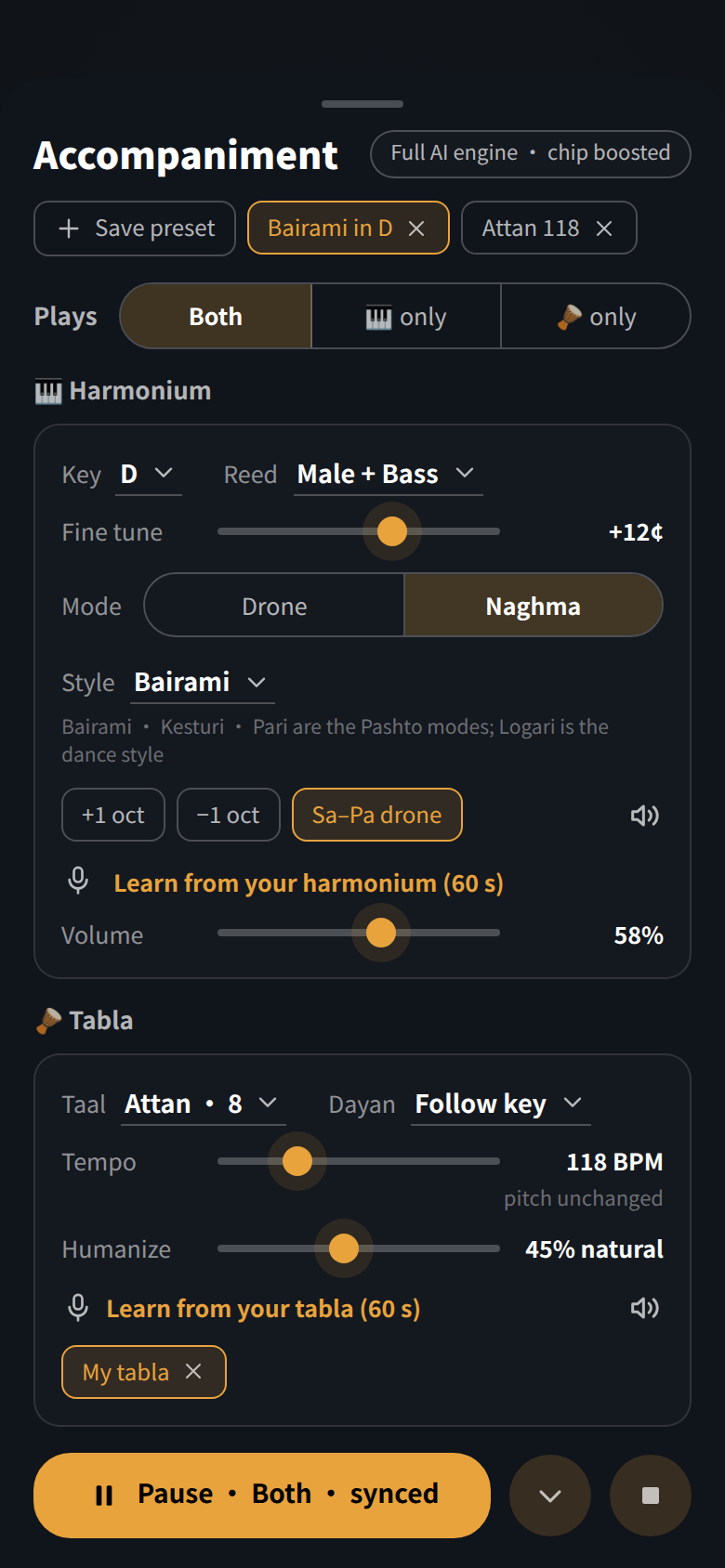
They never drift apart.
The harmonium and the tabla are made together, in one piece, cut to a whole number of tabla cycles. That is why they stay locked: play for fifteen minutes or leave it running for fifteen hours, and the Sam still lands exactly where it should. The loop repeats without a click or a gap, so you stop noticing it is a loop at all.
- A real harmonium sound — two reeds per note, slightly apart, which is where the shimmer comes from. Four reed settings, twelve keys, fine tuning either way, and octaves above or below.
- The Sa–Pa bed — the classic Afghan and Pashto drone, one tap away.
- A tabla that sounds like a tabla — the ring of the dayan and the pressed slide of the bayan, both there.
- The dayan follows your Sa — set it to the harmonium's key, or choose your own.
- Save your setups and give them names. Shrink the console and a small player keeps going while you tune.
- It never confuses the tuner — the app made the accompaniment, so it knows its own sound and ignores it. Your Rabab still reads and glows while it plays.
Eight taals
- TeenTaal · 16 beatsreal tabla
- Keherwa · 8 beatsreal tabla
- Dadra · 6 beatsreal tabla
- Attan · Pashto 8real tabla
- EkTaal · 12 beatsplayed by the app
- Rupak · 7 beatsplayed by the app
- Jhaptal · 10 beatsplayed by the app
- Khattak · 8 beatsplayed by the app
Anywhere from a slow 40 to a fast 320 beats a minute. The recorded taals are re-spaced stroke by stroke rather than sped up, so the drum never sounds squeaky or slowed down.
Five naghma styles
- Kabulithe city style
- Bairamithe Afghan Bhairavi colour
- Logarithe Logar dance style
- Kesturia Pashtun mode
- Paria Pashtun mode
Each one turns around with the taal so the cycle comes home on the Sam. Add a little human unevenness if you want it to sound played rather than printed — and the balance between the two instruments is already set so nothing ever distorts, whatever you do with the sliders.
Your harmonium. Your tabla. One minute.
Press one button, play for a minute, and the app turns your own instrument into a loop you can practise with — cleaned up, trimmed and joined so it repeats smoothly. All of it happens on the phone.
- It won't accept a bad take — too quiet, too short, or nothing really played, and it tells you instead of saving the sound of an empty room.
- Talking in the background is dropped — the way it pulls the harmonium out of the recording leaves voices behind.
- The tuner still understands it — your recorded harmonium keeps its pitch and your recorded tabla keeps its beats, so neither one confuses the tuner.
- Or bring your own file — import a recording you already have.
What gets saved
One sound file per recording, kept privately on your phone under the name you give it. Delete the loop and the file goes with it. It is never uploaded.
How many
As many as you like — each becomes a little tag you tap to choose. They start out called "My tabla" and "My harmonium".
While a loop plays
Strings stop glowing, so a rhythm track can never be mistaken for your playing, and a card on the tuning screen offers to stop it.
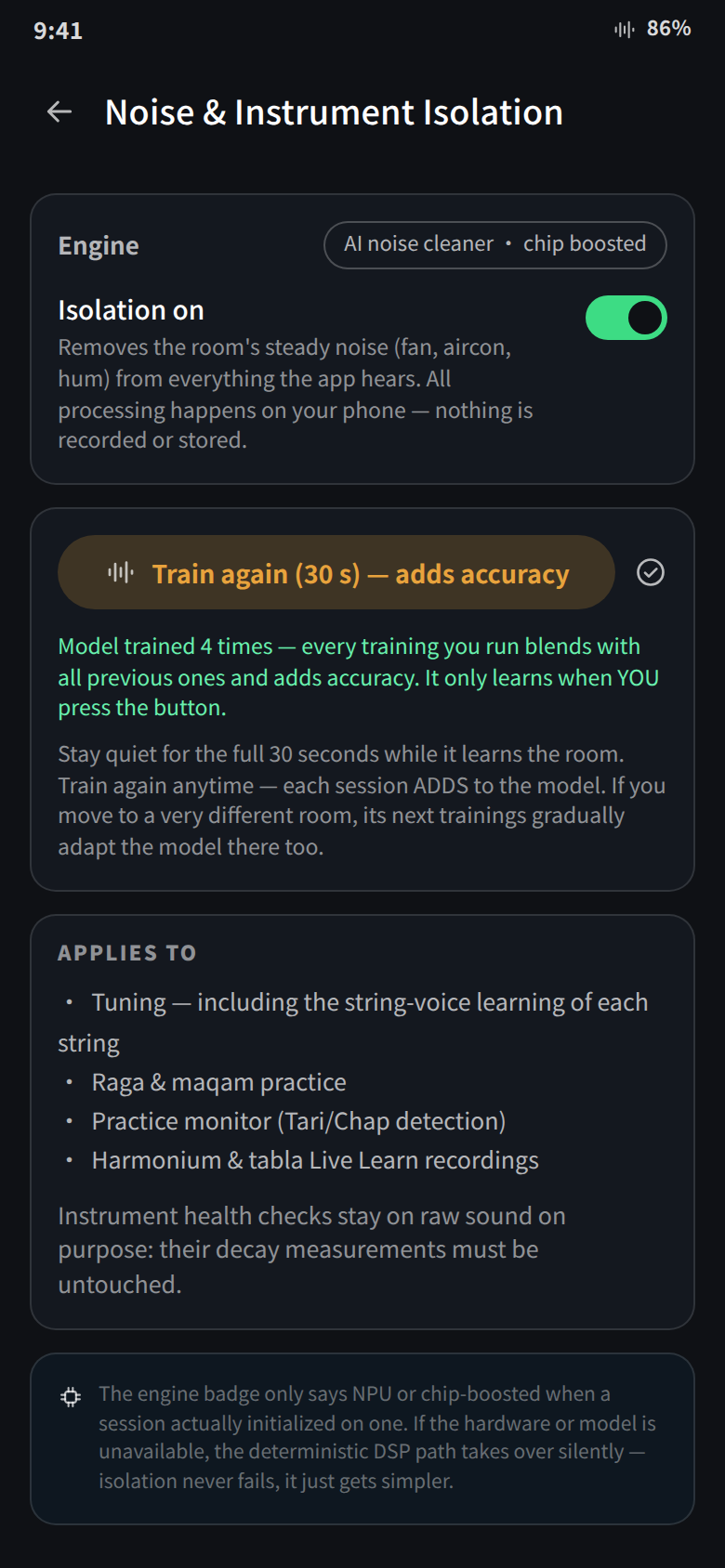
Thirty quiet seconds, and the room stops getting in the way.
Sit still for half a minute while the app listens to your room. From then on it knows what your fan, air conditioner or the hum from the street sounds like, and takes it back out of everything it hears. It doesn't keep the recording — only a description of that steady background sound.
- It helps everywhere — tuning, raga practice, stroke reading, and recording your own instruments.
- Do it again any time — each go adds to what it already knows, and a new room is picked up gradually.
- It only listens when you ask — it never learns the room quietly in the background.
- Off is properly off — with the switch down, the sound reaching the tuner is untouched.
- The check-up is left alone on purpose — measuring how your Rabab rings needs the raw, unfiltered sound.
On newer phones it does a bit more
If your phone has the chip for it, the app uses a smarter clean-up and can even separate a tabla from a harmonium in a recording. If it doesn't, the simpler method takes over and you won't notice — and the app only claims the fancy version when it is genuinely running.
Live preview — this is the app running, not a video
Tari or Chap — learned from your hand.
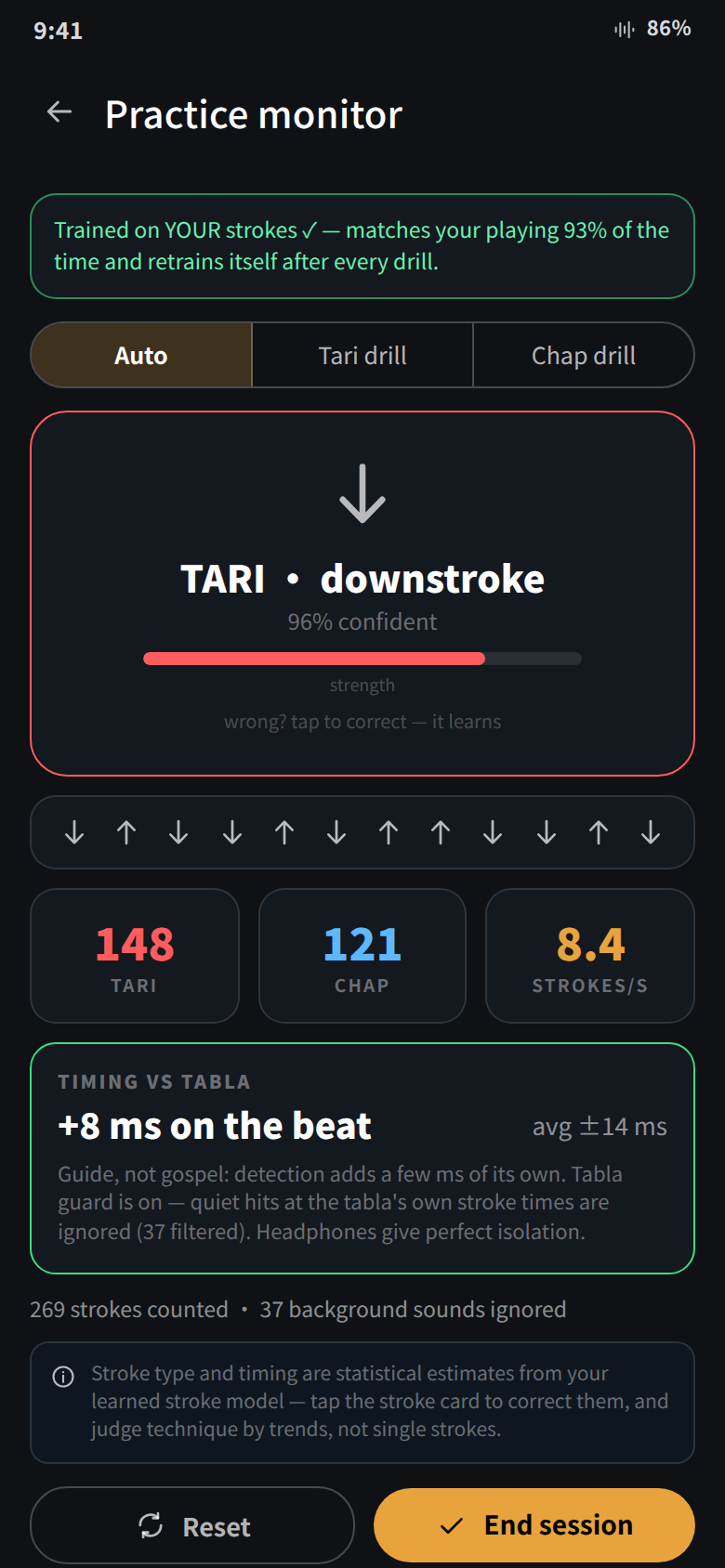
The app hears every stroke of the plectrum and says which direction it went. It works this out from the way your strokes begin, learned from your own playing, and it keeps learning: every drill you run and every correction you make sharpens it. A new install already knows a fair amount, so it is useful from the first day.
- Two ways to teach it — a short guided session of twelve down then twelve up, or simply tell it "these are all Tari" while you practise.
- Tap to correct — one tap fixes a wrong reading, and it remembers.
- Only your Rabab counts — a knock on the table or a door closing isn't counted as a stroke.
- Tabla out loud is fine — the app can tell the drum from your strokes, and headphones make it perfect.
- It looks at whole runs — a fast passage is read as a passage, not as isolated strokes, but a deliberate up-down tremolo is left alone.
What a session tells you
- CountsTari and Chap, with how sure it is
- Speedstrokes per second
- Timingahead of or behind the tabla
- Reportwhat improved, what to work on
- Historyyour last 60 sessions
The app is honest about this: telling a downstroke from an upstroke by sound alone is genuinely hard, because the difference is over in a split second. A short drill teaches it your hand and makes a real difference — and the screen says as much.
Live preview — this is the app running, not a video
Play, and it names the scale.
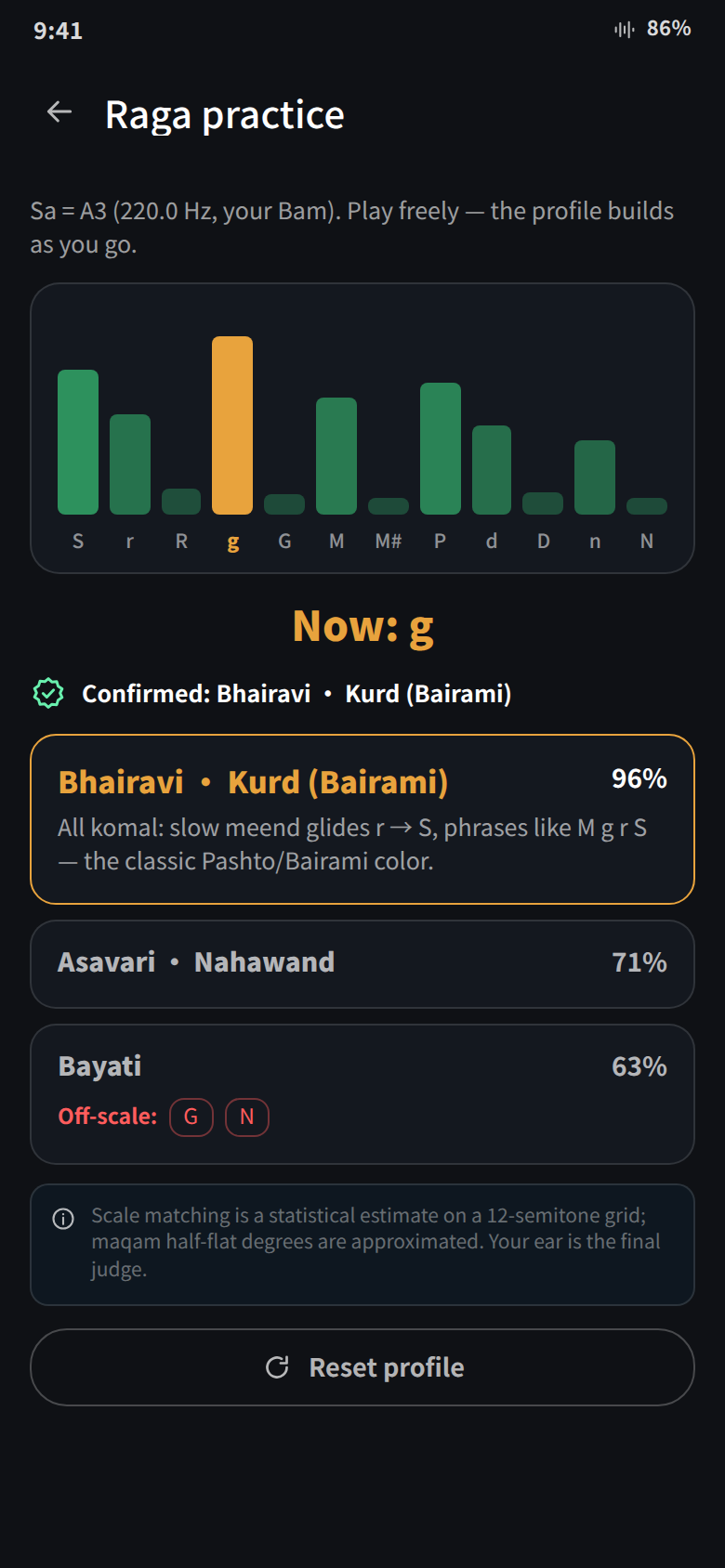
Twelve bars fill up as you play, one for each note above your Sa, showing where you have been spending your time. From that the app works out which raga or maqam you are in — and because it listens finely enough, it can hear the quarter tones that separate one maqam from another.
- It waits until it's sure — instead of guessing early, it tells you which note would settle it: "dwell on R half-flat".
- Three closest matches, ranked, with any notes you played that don't belong marked in red.
- A phrase to try for the leading match, written the way a teacher would say it.
Twenty-four to match against
Where the same scale has two names in two traditions, it is listed once under both.
Amber: the ten thaats · plain: maqam families, with their quarter tones · green: five-note ragas.
The two things that actually ruin Rababs.
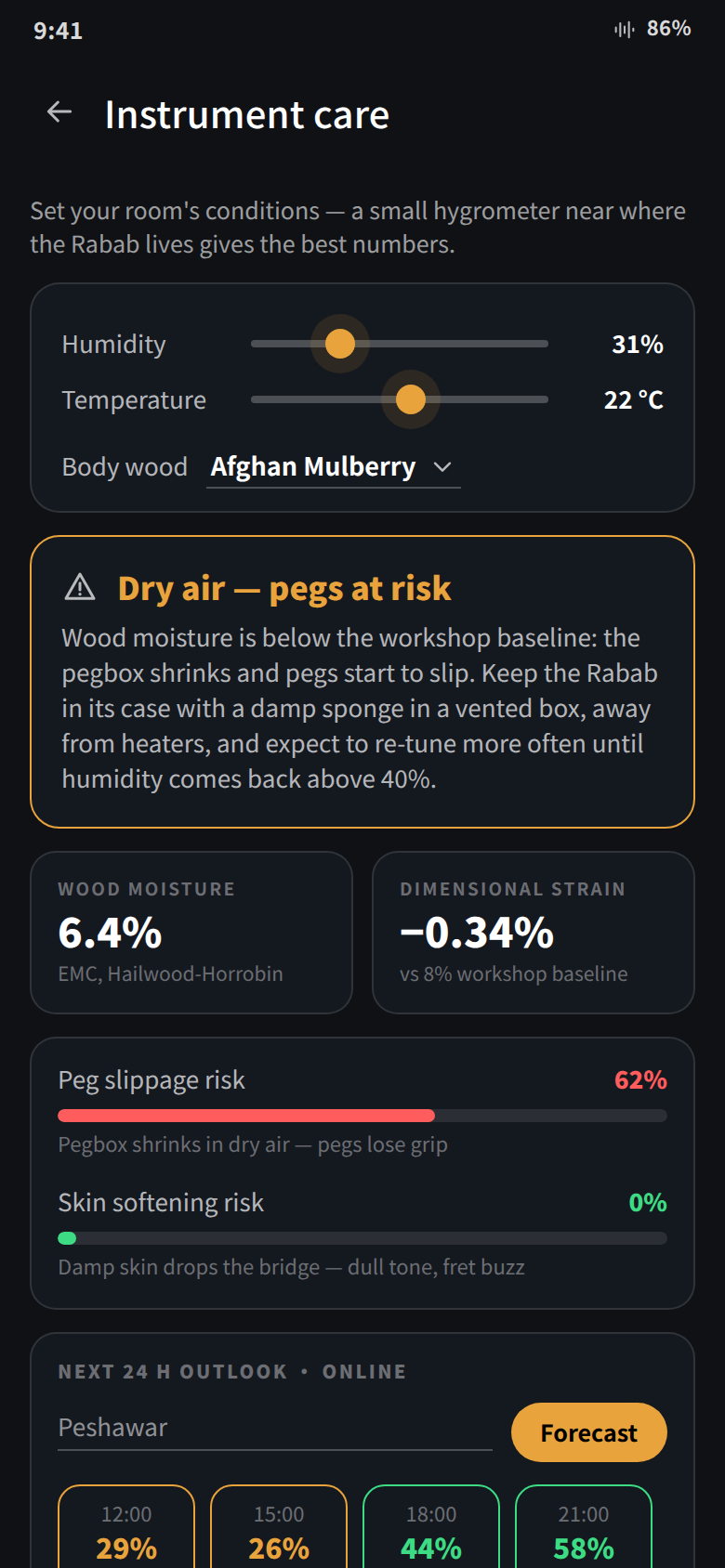
Tell the app how warm and how damp it is where the instrument lives — a cheap hygrometer next to the case gives the truest numbers, and the app says so, because a phone can't measure humidity. From there it works out how much moisture the wood is holding, and what that means for your instrument.
- Slipping pegs — when the air gets too dry the pegbox shrinks and the pegs stop holding.
- A soft skin — when it gets too damp the goatskin slackens, the bridge sinks, and the tone goes dull.
- Choose your wood — Afghan mulberry, walnut or maple. Each one moves differently.
- Real advice, not a colour — case with a damp sponge, a silica pack, warm it up slowly, loosen the strings in heat.
- Which way it will drift — flat, sharp or steady. It won't invent a number it can't know.
- Tomorrow's air, if you want — type a town and see the hours when things turn risky. It asks before going online, and you can switch it off again.
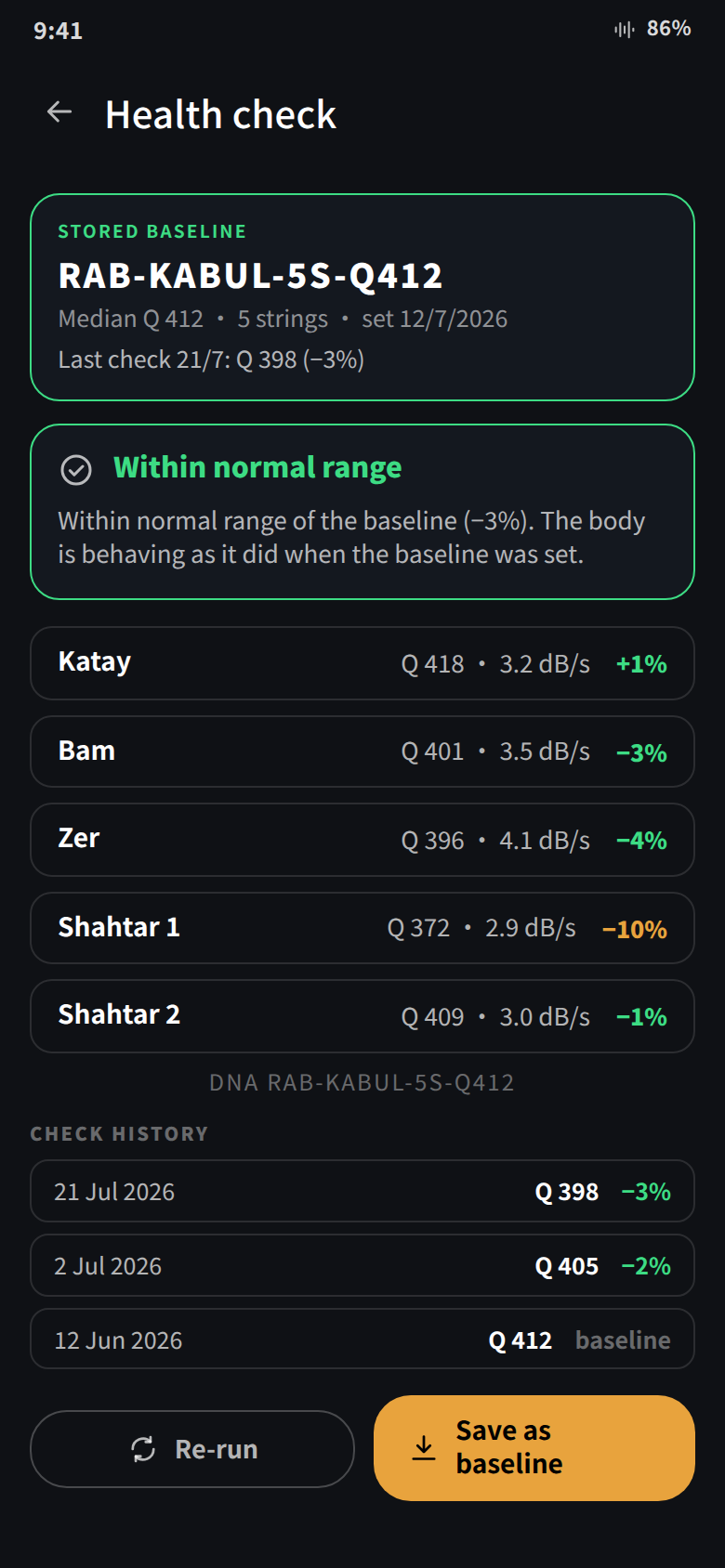
How your Rabab rings, watched over the years.
When wood dries out or a crack starts, the instrument stops ringing for as long as it used to — and that shows up in the sound long before you can see anything. The check-up asks you to pluck each main string once, listens to how long the note takes to fade, and writes it down.
- It only compares you to you — never to some ideal Rabab. The first check becomes your baseline.
- A history of your last two dozen checks, with the date and how each compares.
- A little signature for your instrument, like RAB-KABUL-5S-Q412. Purely for fun.
- Do it the same way each time — same room, same strings — and the numbers mean something.
Set up in a minute
A few short questions the first time you open it: your three melody strings, how many drones, how many Bachi, how many frets, which tuning — and why the microphone helps.
A quick tour
A nine-step walk through the app that runs once and can be replayed any time from the question mark at the top, including a look inside the Tools menu.
Everything in one menu
Saved setups, string pitches, your instrument, extra instruments, care, practice, noise, raga and the check-up. Every one a proper page you can back out of.
Built for when things go wrong
Microphone refused, headphones pulled out mid-session, a loop playing out loud, no internet, an older phone — each of these has a sensible path that keeps the app usable instead of showing you an error.
Easy on the eyes
One dark theme made for a dim practice room, with amber when something needs attention and green when it's right — and a colour for each string, the same on the picture as in the readout: amber Katay, blue Bam, violet Zer, silver Shahtar, cream Bachi.
Ready when your Rabab is.
Everything above is in one subscription, and you can try all of it free first. Version 1.0 is being prepared for both stores.
Billed by Google Play or the App Store, renews until you cancel, and cancelling takes seconds in your store account — what it costs.